HIIVE: An energy-efficient geometry
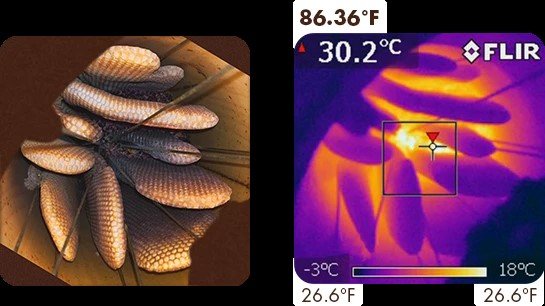
The thermal image shows the temperatures in colours: warm areas usually glow yellow, orange or red, while cold areas appear blue or violet. The brighter the colour, the higher the temperature. This makes it easy to quickly identify heat loss, insulation issues or temperature patterns
The unique cavity of a tree hollow isn’t created by a woodpecker but by a naturally occurring fungus that enters through a broken branch and grows upward with rising moisture. The result is a narrow, cylindrical cavity that allows bees to benefit from natural, dynamic mechanisms to boost their energy efficiency while providing a long-term, stable nesting site.
During winter months, bees form a dense heat plug that separates warm air above from cold air below. As HIIVE bee stewards, you can actually witness how precisely the honeybees regulate airflow – opening or closing the air gap depending on outside temperatures to conserve heat.
Dead wood lacks this ability, losing insulation as it accumulates moisture. But in a HIIVE – or a living tree – the narrow cylindrical shape lets the winter cluster sit centred, slowing air exchange and preserving precious energy throughout the cold months.
Honey = Energy
The science and research behind the HIIVE is based on the insulation and geometric properties of a living tree; as such, bees require far less energy to maintain a stable climate. A colony in a natural tree cavity or HIIVE consume just 5–7 kg of honey over winter, compared to 15–25 kg in typical box hives. This efficiency comes from controlled moisture transport: living trees regulate insulation through xylem vessels, and the HIIVE replicates this with a moisture-balancing barrier.